If you have ever climbed a ladder after a spring storm only to find your gutters packed with pecan hulls, live oak leaves, and wind-blown debris, you have probably asked the question: are gutter guards worth it in Texas? It is a fair question, and the answer depends on the type of guard, the type of trees on your property, and how much you are willing to invest upfront to avoid ongoing maintenance. For homeowners in the Dallas-Fort Worth area, professional gutter installation in Rockwall, TX and surrounding communities has become an increasingly common conversation precisely because North Texas conditions are uniquely hard on gutter systems.
This guide breaks down the gutter guard types that actually perform in heavy Texas downpours, what they cost, and the warning signs that tell you your gutters need protection right now.
Why North Texas Is Especially Hard on Gutters
The DFW region sits in a zone where multiple stressors converge. Live oaks shed pollen, catkins, and small leaves almost year-round. Pecan trees drop leaflets, husks, and nut fragments in fall and winter. Cedar elms release seed clusters in spring. Then come the storms: according to the National Weather Service, North Texas regularly experiences intense convective thunderstorms capable of producing several inches of rain in under an hour.
This combination creates a perfect scenario for clogged gutters. When gutters overflow, the water has to go somewhere, and it typically goes where you do not want it: along your fascia board, into your soffit, down your foundation, and into your landscape beds. Over time, that leads to expensive structural repairs that far outweigh the cost of proper gutter protection.
Gutter Guard Types: What Actually Works in Texas
Not all gutter guards are created equal, and the Texas climate exposes weaknesses quickly. Here is how the four main types perform.
Micro-Mesh Guards
Micro-mesh guards feature a fine stainless steel or aluminum mesh stretched over a frame that sits on top of the gutter. Water flows through the tiny openings while debris slides off the surface. This design handles the broadest range of Texas debris, from pine needles to small seed pods, and it performs well during the high-volume rain events that DFW experiences in spring.
The tradeoff is cost. Professional-grade micro-mesh systems typically run $15 to $30 per linear foot installed. However, for homes with heavy tree coverage, they are the most effective long-term solution and require the least maintenance of any guard type. For more context on micro-mesh performance in wet climates, the University of Illinois Extension and similar land-grant resources have documented how fine-mesh systems outperform other designs in high-debris environments.
Screen Guards
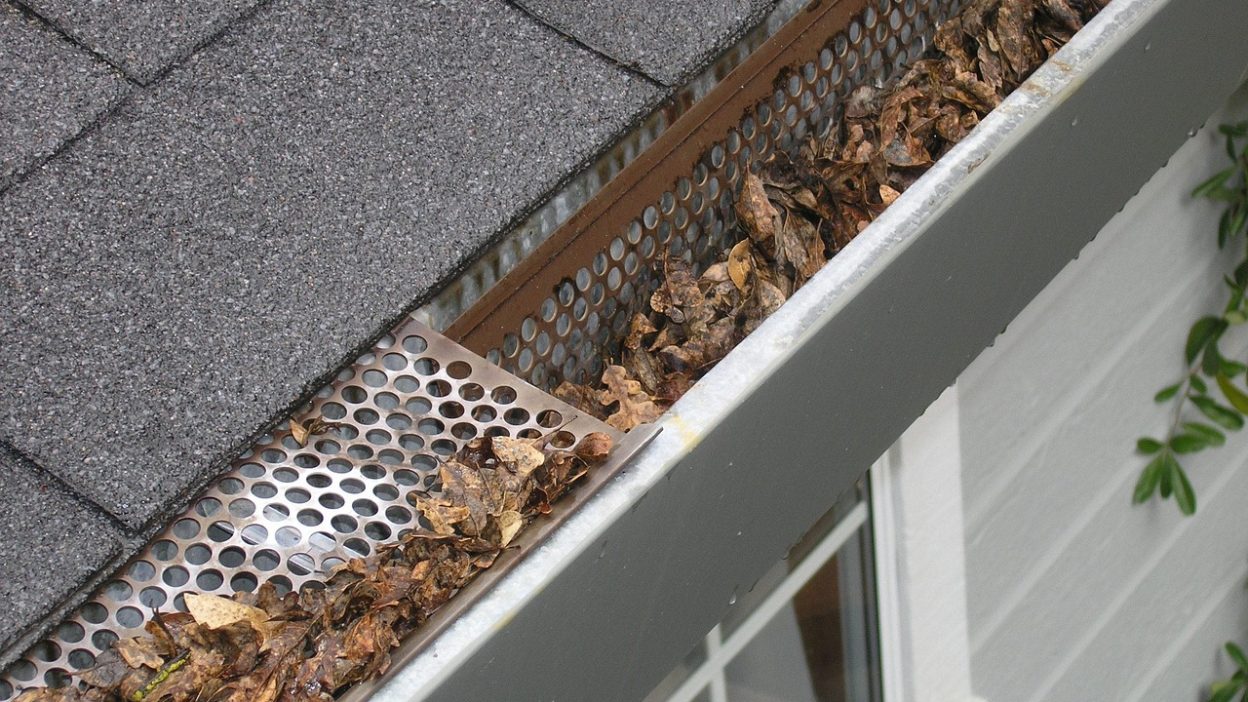
Screen guards are the most widely available product at home improvement stores. They consist of a perforated aluminum or vinyl panel that snaps or slides under shingles. They cost roughly $1 to $2 per linear foot in DIY form and are easy to install.
The problem with screens in Texas is the size of the perforations. Small debris like live oak catkins and pecan leaflets passes right through them and accumulates inside the gutter. They are better than nothing, but homeowners with significant tree cover will likely find themselves cleaning gutters nearly as often as without any guard at all. Screens work reasonably well for homes with minimal tree coverage and a desire for basic protection against larger leaf debris.
Foam Inserts
Foam guards are porous cylinders that sit inside the gutter channel. The theory is that water wicks through the foam while debris rests on top and blows away. In practice, Texas heat accelerates foam degradation, and the pores become excellent breeding grounds for moss, mold, and algae. Debris often becomes embedded in the foam, creating clogs that are harder to clear than if no guard had been installed at all.
Foam inserts are not recommended for North Texas homes. The combination of heat, humidity, and heavy organic debris makes them a poor long-term investment at any price point.
Brush Guards
Brush guards look like large pipe cleaners inserted lengthwise into the gutter. Like foam inserts, they rely on debris resting on top of the bristles rather than falling inside. The problem is that small debris, seeds, and dirt work their way into the bristles over time and are extremely tedious to clean.
These are suitable only for gutters in very low-debris environments, which is a description that does not apply to most DFW neighborhoods. If your property has mature pecans or live oaks overhead, brush guards will create more work, not less.
True Cost Breakdown: What You Actually Pay
Understanding the cost structure helps homeowners make smart financial decisions rather than simply choosing the cheapest option.
DIY snap-in screens run $1 to $2 per linear foot in materials. For a 150-linear-foot gutter system, that is $150 to $300 in materials plus a day of your time. If they reduce cleaning frequency by half but still require annual maintenance, the savings are real but modest.
Mid-range aluminum or steel guards with professional installation fall in the $4 to $8 per linear foot range. These offer better fit and durability than DIY products and are a solid middle-ground option for homes with moderate tree coverage.
Professional micro-mesh systems range from $15 to $30 per linear foot installed, putting a full-home installation at $2,250 to $4,500 for an average DFW home. Many of these systems come with manufacturer warranties ranging from 20 years to lifetime coverage. When you factor in the cost of professional gutter cleaning (typically $150 to $300 per visit) and consider that heavily treed North Texas homes may need cleaning two to four times per year, the math on micro-mesh improves considerably over a 10-year period.
When DIY makes sense: If your home has minimal tree coverage, a single-story roofline you can safely access yourself, and gutters that only overflow in extreme rain events, screen guards at the lower price point are a reasonable starting point.
When professional micro-mesh makes sense: If your home sits under mature pecans or live oaks, has a two-story or complex roofline, or if you have already experienced fascia rot, foundation staining, or overflow issues, the long-term value of a high-performance system is clear. You can verify local contractor ratings and reviews through resources like the Better Business Bureau of Metropolitan Dallas before committing to any installation company.
Warning Signs Your Gutters Need Protection Now
Some homeowners wait until a problem is visible before acting. By that point, repair costs often dwarf what gutter protection would have cost. Watch for these indicators.
Frequent overflow during rain: If water cascades over the front edge of your gutters during moderate rain, the channel is blocked. In North Texas, this often happens at the first spring storm after winter debris accumulation.
Foundation staining or erosion: Dark staining along your foundation or soil washing away near the base of your home suggests overflow has been redirecting water toward the structure rather than away from it. Foundation repair in DFW is expensive, and water-related damage is a leading contributor.
Standing water and mosquito activity: Clogged gutters become stagnant pools. North Texas mosquito season is long and intense, and standing water in gutters provides ideal breeding conditions. If you are treating your yard for mosquitoes but still seeing heavy activity near the roofline, the gutters may be the source.
Fascia and soffit damage: Soft, discolored, or peeling fascia boards along the roofline indicate that water has been sitting against the wood repeatedly. This is both a cosmetic and structural issue. Left unaddressed, it leads to rot that spreads into the roof deck and rafters.
Visible plant growth in gutters: If you can see grass, moss, or seedlings sprouting from your gutters, the debris layer inside is thick enough to support plant life. At that point, professional cleaning and immediate installation of guards is warranted.
Choosing the Right System for Your Property
The ideal approach is to match the guard type to your specific debris profile and budget. Start by observing which trees overhang your roofline and what they shed throughout the year. A home shaded by a large pecan has different needs than one with a single crape myrtle nearby.
For most North Texas homeowners with significant tree coverage, the investment in quality micro-mesh pays for itself within five to seven years when cleaning costs and avoided repair expenses are factored in. For homes with light debris, a quality mid-range guard installed professionally offers a reasonable balance between cost and performance.
You can also read resources from organizations like the American Society of Home Inspectors for guidance on evaluating overall gutter health before choosing a guard system.
Final Thoughts: Weighing the Value for DFW Homeowners
Gutter guards are not a universal solution, but for the majority of North Texas homes situated near live oaks, pecans, and cedar elms, some form of guard system is a sound investment. The key is selecting the right type for your environment and not defaulting to the cheapest option simply because it is accessible.
Screens and foam inserts may seem like easy wins, but they underperform in the debris-heavy, storm-intense conditions that define North Texas weather. Micro-mesh systems cost more upfront but deliver meaningful protection and require far less ongoing attention.
If your gutters are already showing signs of overflow, foundation staining, or structural wear, do not delay. The cost of gutter protection is a fraction of what water damage repairs can run. For homeowners in Rockwall and surrounding communities who want to evaluate their current gutter condition and explore guard options, local professionals familiar with the regional tree and weather profile can provide the most accurate assessment. You can also locate and verify local gutter professionals on Google Maps to find service providers with verified reviews near you.
Frequently Asked Questions
1. Are gutter guards a permanent solution, or do they still require cleaning?
No gutter guard eliminates the need for maintenance entirely. High-quality micro-mesh guards significantly reduce cleaning frequency, but periodic inspection is still recommended, typically once a year. In areas with very dense tree coverage, a biannual check ensures nothing has accumulated on top of the guard surface or worked its way into the channel.
2. Can gutter guards handle the intense rain events common in North Texas?
Micro-mesh and solid-cover guards with nose-forward designs are engineered to handle high water volume. However, extremely intense storms can temporarily exceed any guard’s flow capacity. Ensuring your gutters are properly sized (5-inch K-style for most homes, 6-inch for steep or large roof sections) is just as important as the guard type you select.
3. Do gutter guards affect my roof warranty?
Some guard systems that attach under the first row of shingles can void roofing warranties if not installed correctly. Always confirm with both your roofing manufacturer and the guard installer before proceeding. Surface-mount or clip-on systems that do not touch the shingles typically do not affect roof warranties.
4. How long do gutter guards last?
Lifespan varies by material. Aluminum and stainless steel micro-mesh guards from reputable manufacturers often carry 20-year to lifetime warranties. Plastic screen guards typically last five to ten years before UV degradation causes them to crack or warp, a notable concern in the intense Texas sun.
5. Is it better to replace old gutters before installing guards?
If your gutters are already bent, pulling away from the fascia, or have significant rust or holes, replacing them before adding guards is the right sequence. Installing guards on compromised gutters is a short-term fix that will likely require removal and reinstallation when the gutters eventually fail. A gutter inspection before guard installation ensures the underlying system is sound.